
The cost-effective additive to eliminate casting defects such as veining, penetration, pinholes, shrink, burn in, and lustrous carbon.
Nothing works better than SphereOX® at reducing casting defects in no-bake and resin coated sand mold/core applications. SphereOX® is the ideal additive to minimize the use of costly gas generating resin binder systems while enhancing mold strength!
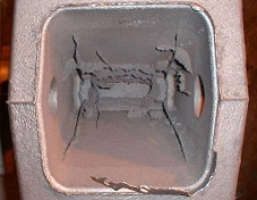
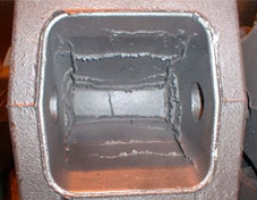
Reduces Casting Defects
Lowers Resin Requirement
Provides Incredible Chill
Less Thermal Distortion
Reduces Emissions
Can Eliminate Need For Coatings
No Dust...Clean Work Environment
Foundries know that the cost of casting rejects and cleanup can make or break their bottom line. The right selection of sand, binder system, and sand additives is critical to reducing these costs.
SphereOX is the ultimate solution for foundries, providing the highest-quality spherical foundry sand additive on the market. This synthetic engineered sand additive is consistently purer than other sand additives or natural oxides, making it the clear choice for foundries looking to improve their bottom line.
By incorporating SphereOX as an additive in foundry cores and molds, surface defects are significantly reduced and the quality of the castings is dramatically improved. Its superior flow properties require less resin to achieve the required mold core bond strength, reducing overall costs even further. When it comes to casting rejects and cleanup costs, SphereOX is the foundry's secret weapon for success.

SphereOX Foundry Sand Additive® is typically added to foundry core and/or molding sand systems as an additive at 2% to 8% by weight for the following intended purposes:
Improve the surface finish of iron, steel, or bronze castings
Eliminate veining on a casting
Eliminate penetration of metal into the mold
Eliminate pin-holes resulting from gas entrapment
Eliminate burn-in and burn-on
Foundries that use SphereOX have reported increased productivity by eliminating cleaning room work through elimination of persistent veining, penetration, and pin-hole problems. Foundries have reported better casting surface finish that results in a casting of higher value. You too can achieve similar savings in machining and cleaning room costs by using SphereOX for iron, steel, or bronze castings.
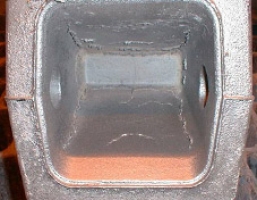
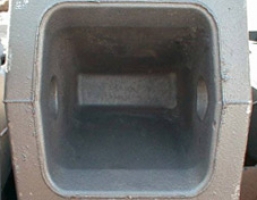
The addition of 8% SphereOX to the core sand system made it possible to cast threads in a Wear Resistant Iron Casting ( Wear Hammer) with no casting defects!
SphereOX’s unique manufacturing method results in a predominantly spherical shape of unique physical and chemical characteristics. SphereOX is the only predominantly spherical, extremely pure iron oxide. SphereOX contains higher FE content than any other commercially available oxide product. It is a finely balanced, critically sized, ferrous product predominantly consisting of Fe3O4.
SphereOX eliminates the most common casting defects caused by parting of molds, gas entrapment, iron or steel penetration, lustrous carbon, and mold expansion. Unlike other additives that contain binders, glues, or other ingredients, SphereOX has no such additives that could increase surface area or add hydrocarbons or any other volatiles that could create gas during casting. Only SphereOX produces a gain on ignition (GOI) of approximately 10% when heated which proves its capability as a gas scavenger.
No-bake resin systems that hold the mold together produce gases. Resins are formulated to provide greater adhesive strength than cohesive strength. The stronger the mold the less chance of parting. Minimizing the quantity of high cost resin but obtaining full coverage one molecule thick is the objective. Round sand and round grain iron oxide maximizes the possibility of obtaining that objective because a round shape minimizes surface area. Foundry technicians are encouraged to inspect SphereOX under a microscope and compare it to competitive iron oxides or any other proprietary foundry sand additive. Notice the significant difference in shape, uniformity of size, and lack of dust when comparing it with any other additive. It is recommended that foundries perform tensile strength comparisons of SphereOX against other additives using varying amounts of additive and reducing amounts of the binder system. SphereOX can typically achieve comparable or higher mold tensile strengths than other additives with a 10% or greater reduction in binder, reducing the quantity of generated gas, volatile organic compounds (VOCs), and hazardous air pollutants (HAPs) during casting.
SphereOX’s spherical shape also allows the passage of harmful gases from the metal/mold interface. Competitive products which are dusty, absorbent, granular, and flake-shaped tend to act as a physical barrier at the mold/metal interface, plugging the mold and preventing beneficial mold gas permeability.
Mold dimension stability is critical for castings. SphereOX has a much higher specific gravity and higher thermal conductivity than sand resulting in more rapid chilling at the mold/metal interface. Rapid chilling assures casting dimension stability. In some cases, SphereOX can be used with silica sand to replace zircon sand. Usually higher percentages of oxide are required such as 5 to 8% by weight.
pH is defined as the negative logarithm of the concentration of hydrogen ions (H+) in a solution. Therefore, if there are no hydrogen ions present in a solution, the pH cannot be measured. In the case of SphereOX, as it has no hydrogen ions, its pH cannot be measured. SphereOx is compatible with most resins and binder systems. It is available in multiple size ranges, but generally as size 75 AFS.
No other additive provides the flowability that is achieved with SphereOX. Conventional additives and iron oxides tends to bridge and flow unevenly in feeder systems resulting in non-uniform distribution in the batch. Non-uniform distribution of additives causes large variations in mold capabilities that may cause casting failures or defects. Typically foundries use extra iron oxide to compensate for poor mixing which only results in higher cost and more variability in the final product.
Naturally occurring magnetite or hematite may contain high percentages of other non-desirable elements. Hematite (Fe2O3), red iron oxide, may be good as a coloring agent or a source of oxygen, but hematite iron oxide is not as efficient as SphereOX because the red iron oxide absorbs resin and lowers tensile strength while not providing much chill. Proprietary additives and competitive grades of black iron oxide usually contain heavy metals, carbonaceous material, and other fillers which also increase resin consumption. Engineered additives can also contain volatiles, which could convert into gases during casting that cause veining, pin-holes and lustrous carbon defects - the defects that you are trying to reduce!
It is interesting to note that before using SphereOX the carbon content is .05%, but after casting the carbon content of SphereOX increased to .7% to .9%. This indicates that scavenging of carbon takes place and helps to explain how SphereOX cures lustrous carbon defects.
Mold tensile strength is critical to quality castings. SphereOX provides higher mold strength than any other additive. This not only reduces veining but also flaking or spalling. Typically additions of 2% to 5% are sufficient to prevent flaking, veining, pinholes, or spalling. Comparison of tensile strength and trials using SphereOX at various additive levels is recommended.
Using SphereOX can also allow for lower pouring temperatures which decreases overall energy cost. Some foundries will pour metal at a higher temperature to reduce the chance of gas entrapment in the casting. Because SphereOX absorbs the gases, it is possible to pour at lower temperatures. For instance, a casting poured at 1425c (2597f) may only have to be poured at 1343c (2450f). This also helps to provide a much smoother surface finish (no burn-in or penetration) even without coating in some cases.
Listen to the resounding praise of our satisfied customers - they'll tell you, ask your foundry workers! They know the true power of SphereOX and the difference it can make in the foundry environment. SphereOX is the ultimate solution to dust-free and non-staining work areas, ensuring a pristine and hygienic working environment that your workers will love.
We at Chesapeake Specialty Products, Inc. are passionate about foundry systems and have a team of dedicated technical specialists and a network of expert distributors who specialize in helping you achieve the best results with SphereOX. Trust us to deliver the highest quality product and support to ensure that you're always making progress with your foundry operations."
LESS COST AND FEWER DEFECTS
SphereOX® vs. Natural Iron Oxide vs. Anti-Veining Agent
SphereOX® has higher Fe (75% vs 63-68%) than mined oxides. Also, because SphereOX® has less surface area, core/mold sand with SphereOX® requires less resin.
Assumptions:
Typical Recommended Additive Addition:
Conventional Oxide 4% in mix at 23¢/lb.
SphereOX® 3% additive in mix at 28¢/lb.
Anti-Veing additive 7% in mix at 40¢/lb.
Typical Resin Addition:
With Conventional Oxide use 1.1% resin at $1.80/lb.
With SphereOX® 1.0% resin at $1.80/lb.
With Anti-Veining 1.2% resin at $1.80/lb.
For 1 Ton Batch:
Sand $60.00/ton delivered = 3¢/lb.

